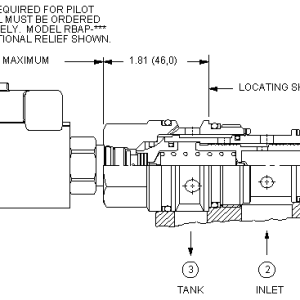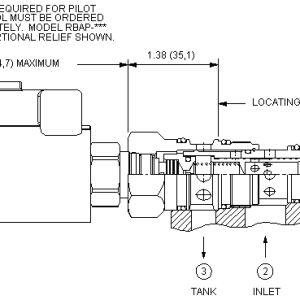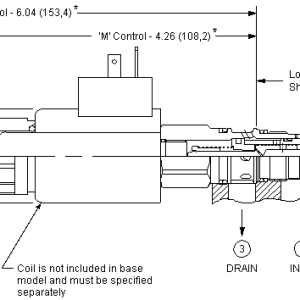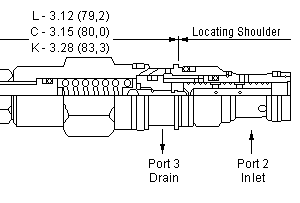
PPHF8WV – Sun Hydraulics Pilot-operated, pressure reducing/relieving main stage with drilled piston orifice and integral T-8A control cavity, Viton seals
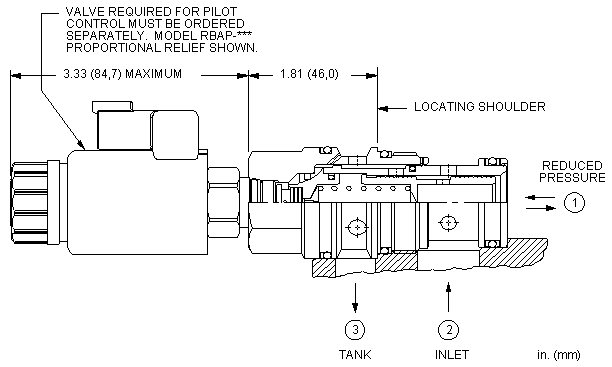
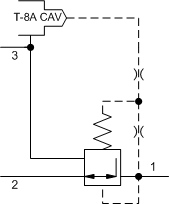


Part number: PPHF8WN · PPHF8-WN · PPHF8 WN
Pilot-operated, pressure reducing/relieving main stage with drilled piston orifice and integral T-8A control cavity. Cavity T-17A, capacity 40 gpm (160 L/min.). Genuine Sun Hydraulics cartridge — MultiFlow is an authorized distributor.
PPHF8-WN overview
PPHF8WN (PPHF8-WN, PPHF8 WN) is a Sun Hydraulics Sun Hydraulics Pilot-operated, pressure reducing/relieving main stage with drilled piston orifice and integral T-8A control cavity, rated 40 gpm (160 L/min.) and installed in cavity T-17A. MultiFlow supplies genuine Sun Hydraulics cartridges in the UAE, GCC and India — use Add to Enquiry above for availability and a quotation.
Ordering codes
Pick the code that matches the material and finish you need. Add it to your enquiry above, or tap a code to select it.
| PPHF8WN | Buna-N sealsBuna-N |
|---|---|
| PPHF8WV | Viton sealsViton |
| PPHF8WE | EPDM sealsEPDM |
Specifications
| Cavity | T-17A |
|---|---|
| Series | 3 |
| Capacity | 40 gpm (160 L/min.) |
| Maximum Operating Pressure | 5000 psi (350 bar) |
| Control Pilot Flow | 15 - 20 in³/min. (0,25 - 0,33 L/min.) |
| Pilot Control Cavity | T-8A |
| Pilot Control Valve Installation Torque | 20 - 25 lbf ft (27 - 33 Nm) |
| Pilot Control Valve Hex Size | 7/8 in. (22,2 mm) |
| Valve Hex Size | 1 1/4 in. (31,8 mm) |
| Valve Installation Torque | 150 - 160 lbf ft (203 - 217 Nm) |
| Model Weight | 1.30 lb (0,60 kg) |
| Seal kit - Cartridge | Viton: 990017006 |
Compound cartridge (pilot and main stage) assembly information is provided for reference only. Cartridges must be ordered separately and assembled at point of use.
How to read PPHF8WN
Sun part numbers are the model followed by one code per option. Hyphens, slashes and spaces are only dividers, so PPHF8WN, PPHF8-WN, PPHF8 WN are the same part.
| Model | PPHF8 — Sun Hydraulics Pilot-operated, pressure reducing/relieving main stage with drilled piston orifice and integral T-8A control cavity |
|---|---|
| Minimum Control Pressure | W — 100 psi (7 bar) |
| Seal Material | N — Buna-N |
| Material / coating | Add /AP (stainless steel, passivated) or /LH (mild steel, zinc-nickel) to the end; no suffix is the standard finish. |
Minimum Control Pressure options
- D — 25 psi (1,7 bar)
- W — 100 psi (7 bar)
Seal Material options
- N — Buna-N
- V — Viton
- E — EPDM
Manifold & standard assemblies
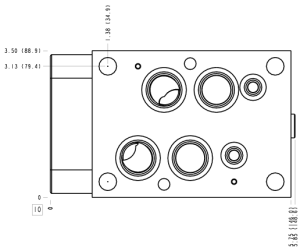
Sun manifolds for cavity T-17A (377)
- BJO Sun Hydraulics ISO 05 – X&Y: On P, port 3 to T Sandwich manifoldPPHF8WV-BJO — request assembly
- BK2 Sun Hydraulics ISO 07: Reducer on A with reverse flow check Sandwich manifoldPPHF8WV-BK2 — request assembly
- BK4 Sun Hydraulics ISO 07: Sequence into A with reverse flow check Sandwich manifoldPPHF8WV-BK4 — request assembly
- BK5 Sun Hydraulics ISO 07: Sequence into B with reverse flow check Sandwich manifoldPPHF8WV-BK5 — request assembly
- BK6 Sun Hydraulics ISO 07: Sequence out of A with reverse flow check Sandwich manifoldPPHF8WV-BK6 — request assembly
- BK7 Sun Hydraulics ISO 07: Sequence out of B with reverse flow check Sandwich manifoldPPHF8WV-BK7 — request assembly
- BK8 Sun Hydraulics ISO 07: Cushion lock Sandwich manifoldPPHF8WV-BK8 — request assembly
- BK9 Sun Hydraulics ISO 07: Reducer on A and B with reverse flow check Sandwich manifoldPPHF8WV-BK9 — request assembly
- BKA Sun Hydraulics ISO 07: On A, port 3 to B Sandwich manifoldPPHF8WV-BKA — request assembly
- BKB Sun Hydraulics ISO 07: On B, port 3 to A Sandwich manifoldPPHF8WV-BKB — request assembly
- BKC Sun Hydraulics ISO 07: On A, port 3 external Sandwich manifoldPPHF8WV-BKC — request assembly
- BKJ Sun Hydraulics ISO 07: Reducer on B with reverse flow check Sandwich manifoldPPHF8WV-BKJ — request assembly
Technical features
- These valves have the main stage orifice drilled into the piston rather than a staked-in orifice. This allows the valve to survive physically demanding applications.
- Maximum pressure at port 3 should be limited to 3000 psi (210 bar).
- Pressure at port 3 is directly additive to the valve setting at a 1:1 ratio and should not exceed 3000 psi (210 bar).
- Maximum inlet pressure is determined by the bias spring. The D spring is tested with 2000 psi (140 bar) maximum differential pressure and the W spring is tested with 5000 psi (350 bar) maximum inlet pressure.
- NOTE: With the -8 control option, the main stage valve should first be installed to the correct torque value. The T-8A pilot control valve should then be installed into the main stage valve to its required torque value.
- The -8 control option allows the pilot control valve to be incorporated directly into the end of the relief cartridge via the T-8A cavity. These pilot control cartridges are sold separately and include electro-proportional, solenoid, air pilot, and hydraulic pilot operation. See Pilot Control Cartridges.
- Pilot operated valves exhibit very low dead-band transition between reducing and relieving modes.
- Pilot operated valves exhibit exceptionally flat pressure/flow characteristics, are very stable and have low hysteresis.
- All three-port pressure reducing and reducing/relieving cartridges are physically interchangeable (i.e. same flow path, same cavity for a given frame size). When considering mounting configurations, it is sometimes recommended that a full capacity return line (port 3) be used with reducing/relieving cartridges.
- Full reverse flow from reduced pressure (port 1) to inlet (port 2) may cause the main spool to close. If reverse free flow is required in the circuit, consider adding a separate check valve to the circuit.
- Incorporates the Sun floating style construction to minimize the possibility of internal parts binding due to excessive installation torque and/or cavity/cartridge machining variations.
Drawings, symbol & performance curves
Downloads
Datasheet
Technical reference sheets
- 999-901-334 (PDF 344 KB)
- FloatingStyleScrewInCartridge2 (PDF 1 MB)
- TT_US_Amplifier-New (PDF 2 MB)
- TT_US_Cavity-New (PDF 522 KB)
- TT_US_Red-Rel (PDF 229 KB)
- TT_US_coils-New (PDF 975 KB)
- rel-Prop_terms-definitionsN (PDF 3 MB)
CAD files
Frequently asked questions
Is PPHF8WN the same as PPHF8-WN?
Yes. Sun Hydraulics writes this part number as PPHF8WN. It is the model PPHF8 followed by the configuration code; hyphens, slashes and spaces are only dividers, so PPHF8WN, PPHF8-WN, PPHF8 WN all refer to the same product.
Do you supply PPHF8WN in the UAE, GCC and India?
Yes. MultiFlow supplies genuine Sun Hydraulics cartridges, including PPHF8WN, to customers in the UAE, the wider GCC and India. Use Add to Enquiry on this page for availability, lead time and a quotation.
Can I get the datasheet and CAD files?
Yes. The datasheet, technical reference sheets and CAD files (DXF, DWG, STP) are listed in the Downloads section of this page.
Will your reducing/relieving valve relieve my pump to tank?
No. A reducing/relieving valve throttles a supply of oil to maintain a set pressure in a secondary circuit. The valve is open until the secondary or downstream pressure rises to the setting of the valve at which time it starts to close to limit the pressure. If the secondary or downstream pressure is caused to go above the setting, the valve shifts into relieving mode and throttles the secondary circuit back to tank to prevent over-pressure. At no time can the valve connect the supply to tank.
How big is a drop of hydraulic oil?
There are exactly 250 Sun drops in a cubic inch or 15 in a cc.
Direct acting or pilot operated - what do I use?
Direct-acting valves are used to prevent over pressure, and pilot-operated valves are used to regulate pressure. If you are unsure, use a direct-acting valve. Sun's direct acting valves are very fast, dirt tolerant, stable, and robust. Sun's pilot-operated valves are moderately fast, they have a low pressure rise vs. flow curve, and they are easy to adjust.
Can I back flow through a reducing valve from port 1 to port 2?
Yes. A reducing or reducing/relieving valve is normally open. If the pressure in the secondary circuit is less than the setting, it will be open.
2 caveats: (1) If the valve is in the reducing mode and you suddenly reverse the flow, the valve will not have time to open and will shift into relieving mode or (2) If the back flow generates a pressure drop through the valve that exceeds the setting, the valve will shift into the relieving mode.
When in doubt, use a reverse flow check.
What are the tolerances on pressure settings for Sun's pressure control valves?
Pressure setting tolerances are listed in our Performance Data page. A link to this page can also be found in the Additional Resources tab of the applicable product page.
I need a reducer on B. Can I connect the drain to A?
Yes. If you look in the sandwich section you will see that we offer many such packages. When you are pressurizing B, A is connected to tank, allowing the reducer to do its job. When you reverse, the drain or tank port of the reducer is pressurized by A. This increases the setting of the reducer and helps keep the reducer open in the reverse flow direction.
What do you mean by maximum differential?
Our reducing valves are outside-in valves; the supply pressure on the outside of the working parts is higher than the inside. At some pressure differential, the outside (sleeve) will close in on the piston and cause the valve to stick. A D range is adjustable from 25 to 800 psi with a maximum differential of 2000 psi. This means you could set the valve at 600 psi and expect it to work correctly with a supply pressure of 2600 psi. The valve may work at higher differentials, but we do not recommend it. The W and C ranges are tested over their entire range with an inlet pressure of 5000 psi. All direct-acting valves are tested with an inlet pressure of 5000 psi.
What parts of the Sun cartridge valve are field serviceable?
Manufacturer reference: https://www.sunhydraulics.com/model/PPHF8